Friday, May 18, 2007

Graduation!!!!

Tears, flowers, special guests, pictures, Jivamukt alumni, more pictures, surprise visitors, kirtan,hugs, even more pictures, smiles, laughter, presents, and some more pictures.......

That is pretty much all I remember from last night. It was all such a whirl, kinda like this entire month, and it just flew by. We had our final exam the day before, a comedy skit in the afternoon, our graduation picture before dinner, and then dinner. It was lovely - specially prepared by the Omega staff and full of surprise visitors and guests. Senior Jivamukti Teachers Nicole Nichols and Michael Hewett came up from NYC, and it was nice to reconnect after having see them during their visit to DC before the Teacher Training. Other alumni teachers came in from everywhere, including Colorado, South Carolina, and Virginia Beach. And then a special surprise visitor blessed us with his presence; Shyam Das, a dear friend of David and Sharon and gifted kirtan singer, author, and translator, showed up at dinner. David and Sharon said this was the first time Shyam Das made an appearance, and the only graduation to be graced with live performance chanting by one of the world's greatest kirtan masters!

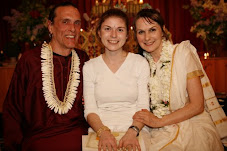
Our graduation ceremony followed dinner and was lovely. We each were called up one by one, and got a flower, certificate, and picture with David and Sharon. A fellow TT'er from Germany, who is a professional photographer, volunteered her services to take an individual photo of each graduate with David and Sharon. I can't wait to get mine!

And so, it is done. We are all now certified Jivamukti Yoga Teachers. Or, as our mentor Alanna named us, "certified Jivamukti rock stars." It flew by so quickly and now its all over. Everyone is packing up this morning and heading out. But, as Alanna beautifully said last night, we are now part of one big extended family, spanning the entire world.

Jivamukti rocks on!

Tuesday, May 15, 2007

Dance Party with David Stringer

"India blasted me into billions of spinning particles and then slowly reshaped me, a process that was somehow simultaneously both excruciating and ecstatic. I can't begin to claim complete knowledge about all of the layers of history and philosophy and theology represented by the mantras I learned to chant while I was there, but I can attest to their power. I'm not a Sanskrit scholar and not always a particularly focused practitioner, but I am deeply committed to the process of inquiry that the practice of yoga suggests." --David Stringer

We are coming to the end of our teacher training, and everyone is getting stressed about the coming final exam. Tonight, however, we were told to be ready for a surprise, and not worry about the exam or stress about studying. Everyone was excited and guessing about what the surprise could be........and we were all so ecstatic to find out that we were being blessed with the presence of David Stringer and his band!

David Stringer is one of the foremost leaders in the American kirtan movement. Kirtan is a form of chanting that is growing more and more popular within the Western yogic community. It is simple: a lead group calls out the melodies and the mantras and the crowd responds, clapping and dancing as the rhythms build and accelerate. It is amazing how powerfully transformative the experience becomes as you let go and get absorbed in the passion of the music -- all representing the universal longing and passion for the Divine.

Read the PDF written by David Stringer on the Philosophy of Kirtan

The evening consisted of a series of Sanskrit mantras whose deep meanings stimulated an intense letting go of our individual anxieties, worries, and insecurities - and allowed us all to go beyond ourselves and into a beautiful union of humanity, all singing and dancing in euphoric joy, in celebration of life. We learned about the deep power of mantra from Manorama, who had earlier taught us Sanskrit. This time we really had the chance to experience their full power.

From David Stringer's website:

"Mantras are intended as a tool with which the spirit can release itself from the prison of attachments that the mind creates. It's not unfair to say that the chanting of mantras is intended to be a completely mindless activity, since the intention of chanting is to create an ecstatic state of awareness that is beyond mind. Yoga doesn't ask us to believe, it asks us to practice, examining our experience until we can witness the truth in the book of our own heart. No one else can read it for us, or tell us what it means. Ultimately, whether mantras are ancient wisdom or psychological metaphor or complete nonsense depends on the intention and experience of the participant."

It was such an incredible evening. I definitely recommend you check out his music! Almost everyone in the teacher training ended up buying his two CD's: Mala and Japa.

Check out his website: http://www.davestringer.com/


david stringer

Dave Stringer has been profiled in Time, Billboard, In Style, and Yoga Journal as a leader of the new American kirtan movement. Dave's sound marries the transcendent mysticism of traditional Indian instruments with the exuberant, groove-oriented sound of American gospel music. A spontaneous and articulate public speaker, he probes the dilemmas of the spirit with a sly and unorthodox sense of humor. His work translates the ancient traditions of kirtan and yoga into inspiring and thoroughly modern participatory performance.

"Listen friend, this body is his instrument. He draws the strings tight, and out of it comes the music of the universe."
--- Kabir

Some teachings on teachers

It doesn't matter what type of teacher you have in your life, but what matters and will determine whether you achieve liberation is your devotion to that teacher. It is actually your job as the student to make the teacher enlightened by seeing them as already enlightened. Likewise, it is the duty of the teacher to see the students as holy beings, thus making them so.

However, according to Yogi Sri Krishnamacharya (the grandfather of most of the styles of yoga in the West), three things will make a good yoga teacher:
  • connection to lineage: the teacher should aways acknowledge their own teachers, have studied with their teachers personally and been blessed by them to teach
  • practice: the teacher should have a consisent, daily sadhana practice which informs their own teachings and keeps them fresh and grounded
  • sincere love of others: the teacher must really care about other people and want them to be happy; the student-teacher relationship must be founded on pure, unconditional love
David and Sharon are great examples of all three of these qualities. Their tireless attention to their students is always infused with great love and joy, their perfection of yoga comes from their continued experimentation and study, and they always acknowlege and bless their holy gurus. Who are the Jivamukti holy gurus? These are Jivamukti's three holy teachers:
  1. Swami Nirmalananda
  2. Shri K. Pattabhi Jois
  3. Shri Brahmananda Sarasvati

Taken from the Jivamukti website:
Shri K. Pattabhi Jois

Shri K. Pattabhi Jois studied yoga under his guru Shri Krishnamacharya and also attended the Sanskrit College of Mysore, where he became a professor of Sanskrit and Advaita Vedanta. He and Shri Krishnamacharya developed the Astanga Yoga series based on the purifying practices described in the ancient texts. In 1948, he founded the Ashtanga Yoga Research Institute in Mysore. In 1958, he wrote his classic book Yoga Mala, which explores Astanga and Yoga philosophy. In 1998, David Life was made a certified Astanga teacher by Shri K. Pattabhi Jois. Both Sharon and David make regular trips Mysore to study under him.

"Ahhhh Samadhi. Yoga is Samadhi. God is One. Yoga is One. Philosophy is One. That's All.
- Shri K. Pattabhi Jois

Pahtabi Jois photo
Brahmananda Sarasvati photo
Shri Brahmananda Sarasvati

Shri Brahmananda Sarasvati had an extensive background in Eastern and Western medicine. In 1958, he founded the Yoga Society of New York. Ananda Ashram, which he founded in 1964 in Monroe, New York, continues to be devoted to Shri Brahmananda Sarasvati's teachings and message, and the ashram hosts many Jivamukti events. A Sanskrit scholar, his life was dedicated to the union of science and the spirit. He is the author of Fundamentals of Yoga, The Textbook of Yoga Psychology (one of the definitive translations of Patanjali's Yoga Sutras) and Self Analysis and Self Knowledge, along with many essays. He left his body in 1993.

"Nobody is a fool and nobody is wise. It is the space which makes you foolish or wise. If you have space within your mind, then you become wise, and if you have no space in your mind, then you become 'otherwise'."
- Shri Brahmananda Sarasvati

Shri Swami Nirmalananda

Swami Nirmalananda believed in the potency of Self rule, and he called himself the "Anarchist Swami." He inducted David Life into the sunnyas (renunciate) order in 1990. Swami Nirmalananda was a naturalist and a "mauni". He practiced silence for 11 years. "Unless the individuality is transcended, we cannot know what is universality and unless we die while living, we cannot know what is Eternal life. The mind can only think one thing at a time and it always functions within the realm of duality like good and bad, pleasure and pain, happiness and sorrow. Unless we rise above these pairs of opposites, we will not be able to know what the integrated state of existence is."

"Love not anyone, not even God!
Our picking and choosing love brings misery.
Instead, let God love you. Be Love itself."
- Shri Swami Nirmalananda

Swami Nirmalananda photo

Monday, May 14, 2007

The First Yogi - Lord Śiva

The Emergence of the Ganga on the Earth

Lord Śiva has been very, very present throughout this teacher training. Of course, there is the beautiful Śiva wall hanging that I received from Jill, which has been on my wall in my bedroom since I arrived. But his presence has been felt in other ways. During evening satsang, we often chant together and the chants MOST recited are ones concerning Śiva. His image also keeps popping up everywhere - in statues, wall decorations, and even T-shirts. But of course, I shouldn't be surprised since Lord Śiva IS the god of the Yogis.

Lord Śiva is the original yogi. His main attributes are his trident, which represent the three gunas; snakes that show he is beyond the power of death and also represent Kundalini; his wild, unkempt hair that he refuses to shorn; and a tiger skin upon which he sits perched, that represents the mind.

Lord Śiva is full of contradictions. He is self-controlled and celibate, but also the original "wild" man. He is both static (often depicted as in a meditative trance) and dynamic (see as the Cosmic Dancer). He is the greatest of renouncers (the master Yogi) as well as the ideal lover (joined with Shakti). As the Cosmic Dancer, Lord Nataraja, his dance is the interplay of both destruction and creation, a dance of death and regeneration. The joining of all these contradictions in the body of Lord Śiva represents the teaching that all seemingly opposites that exist (good/evil, female/male, birth/death) eventually merge into one, into oneness. Into the ONE that is, the only reality, into Brahman.

Lord Śiva represents the Ajna Chakra, the third eye center. His spouse, Shakti, is the coiled snake named Kundalini that lies dormant at the Muladhara Chakra (pelvic area). The practices of yoga are designed to awaken Kundalini from her respose and lead her up the sushumna nadi, the central energy channel, through all the chakras until she reaches her beloved Śiva at Ajna. The wedding of Kundalini with Shiva is a symbol of the highest bliss attainable by an individual soul. This union of Śiva-Shakti is the union of yoga, the union of opposities, the realization of ONENESS. This is what we all work towards when practicing yoga.

Other names for Śiva:

Mahāyogi (Sanskrit महायोगी)- The Supreme Yogi
Nāgaraja (Sanskrit नागराज) - King of snakes
Shambhu (Sanskrit शम्भु) - Abode of Joy
Tryambakam (Sanskrit त्र्यम्बकम्) - Three-Eyed One, i.e. All-Knowing

Friday, May 11, 2007

Pranayama practices

Pranayama - the regulation of inhalation, exhalation, and suspension of breath by modulating their lengths and holding for a time, while directing the mind consciously into the project.
 
Pranayama is emphasized in yoga because it allows us to feel the cosmic energy of prana -- the life force. To clear a common misperception, our breath is not the same as our prana; however, our prana rides on the breath and we can get in touch with it through our breathing. David and Sharon tell us to think of prana like electricity. This power source is running throughout our bodies and the aim of a yogi is to harness this tremendous power and direct it towards enlightenment. We do this by learning how to channel this electricity into our wires ( nadis) and then directing it towards a specific direction. The nadis are the energy channels which conduct our energy source, our prana. All of this occurs in the subtle body of the human being.

On a surface level, pranayama benefits the gross body by oxiginating the blood and energizing the body. But a yogi always looks deeper, and when we examine the affects of pranayama on the subtle body, we see that it works to cleanse the nadis, which have been clogged up by avidhya, or mis-knowing. So, in other words, pranayama practices work like Draino - they help you unclogg your pipes in order to get the flow moving swifly again.

In order for breathing practices to be pranayama, they must have the following components (which are commonly missed), according to the Hatha Yoga Pradipika:

  • establishing a "seat" that is one of these four asanas: padmasana, siddhasana, vajrasana, or virasana
  • use of bandhas (mula bandha, uddiyana bandha, jalandhara bandha)
  • breath retention (kumbaka)
Because the first two requirements (seat and bandhas) are advanced practices in and of themselves, pure pranayama is usually not introduced to the yogi until a later stage when these have been mastered. The seat ( padmasana, siddhasana, vajrasana, or virasana) must be steady and joyful, meaning the yogi must be comfortable, well-connected to the Earth, and able to stay in this position for about 20 minutes. That is hard! These four options are not easy asanas to hold, or even get into! Likewise, the yogi must have mastered the usage of bandhas in order to then incorporate them into their proper placements during the exercises. Lastly, breath retention, kumbaka, should only be attempted once the yogi has perfected "equal breathing" or equalizing the inhale and exhale smoothly throughout the entire vinyasa. Not as easy as it seems.......
 
So, basically, David told us it could take a yogi years to perfect himself to the point of becoming ready for pure pranayama practices. In the meantime, however, the yogi should focus on breath awareness, equal breathing throughout practice, and ujjayi breathing. Ujjayi breathing is a great way to start learning how to restrict the breath and prepares the yogi for future breath retention practices. That is enough in and of itself to focus on, isn't it!??!

Thursday, May 10, 2007

Sharing Silence

For the next week, we will be having silent meals during breakfast, lunch, and dinner. This coincides with a mindfulness retreat being held here at Omega with visiting monks and nuns of Plum Village. These monks and nuns leading this retreat have lived in Plum Village with Thich Nhat Hanh for many years, and among them are those who have received from him the Lamp Transmission authorization to teach Buddhist meditation in his lineage. Thich Nhat Hanh is a Buddhist monk whose mindfulness teachings have inspired hundreds of thousands of people around the world, and made him a well-loved spiritual teacher in the West. His message is simple and coincides perfectly with that of Jivamukti: bringing peace into our own lives brings peace into the world.


In solidarity with these holy beings, we will be participating in their practice of mindful eating during the meals. Here are the instructions for the practice from our Jivamukti Teacher Training manual: 
 
"Eating in silence allows us to see the preciousness of the food and our close relationship with the Earth and all species. Every vegetable, every drop of water, every piece of bread contains the life of our whole planet and the sun. With each bite of food, we can taste the meaning and value of our life. We can meditate on the plants and animals, on the work of the farmer, and on the many thousands of adults, children, and other animals who die each day for lack of food."
 
Before eating, a bell will be rung three times and we will ponder the five contemplations:
 
1. This food is a gift of the whole universe,the earth, the sky and much mindful work.
2. May we eat in mindfulness so as to be worthy of it.
3. May we transform our unskillful states of mind and learn to eat in moderation.
4. May we take only foods that nourish us and prevent illness.
5. May we accept this food to realize the path of understanding and love.
 
"Drink your tea slowly and reverently, as if it is the axis
on which the world earth revolves - slowly, evenly, without
rushing toward the future. Live the actual moment.
Only this moment is life."  -Thich Nhat Hanh


Friday, May 4, 2007

Jivamukti as a form of "Integral Yoga"

Long, long ago -- maybe even before the Indian civilization took up yoga -- ancient sages pondered the various ways of attaining enlightenment. They took a look at what they had to work with and saw they had three things - heart, head, and hands. And out of these "tools" evolved different systems which we now know as yoga.

We know yoga was highly developed by the Indian civilization, but Sharon told us there is evidence of yoga existing even before then; evidence has been found of yoga-type influences in the Egyptian mystery schools. Who really knows; what we do know, though, is what yoga has become for us now in modern day. And it is a fairly complex picture, isn't it?! Although there are already TONS of types of yoga advertised out there, yoga can actually be categorized into more than just the physical hatha yoga practice known best by the West. Going back to the "tools" discovered by the ancient sages, there are four basic types of yoga which use these tools differently.


1. HEART - Bhakti Yoga


This yoga uses emotions and directs them towards devotion for the Divine. In this way, they develop an intense personal relationship with God characteristic of a human relationship. The "bhakta" perceives the world through his heart and embraces fully all emotions because they all lead to God. As yogis, we intuitively understand the importance of the heart, but science is only now slowly catching up. Some scientists are now labeling the heart as an organ of perception equal to the brain. Bhaktas have known this all along, and have shared their experiences with us through the ages. Here are some examples of bhaktas (who have come to us from all religions):


Neem Karoli Baba, and his devotees to include Ram Das, Shyam Das, Bhagavan Das, Krishna Das, Durga Das, and many many others


"Everything is impermanent, except the Love of God" --Neem Karoli Baba

Rumi whose love for God found its expression in an outpouring of music, dance and lyric poems

"Love’s nationality is separate from all other religions,
The lover’s religion and nationality is the Beloved (God).
The lover’s cause is separate from all other causes
Love is the astrolabe of God’s mysteries." --Rumi


2. HANDS - Karma Yoga


This yoga focuses on the perfection of action through the performance of selfless service. The secret to service, though, is performing the acts with absolutely no expectation of personal benefit but fully as an offering to God.


Mother Theresa saw everyone she served, the most destitute and desperate people of India, as Christ incarnate and selflessly devoted herself to them.


"I am a little pencil in the hand of a writing God who is sending a love letter to the world." --Mother Theresa

3. MIND - Jnana Yoga

This yoga uses the faculty of the intellect, the rational mind to understand the mind. The principle method of this type of yoga is the practice of self-inquiry, constantly analyzing and questioning "who am I?"In this way, the yogi strips away who they are not, and keeps negating their identity until they get to their essential Being. Methods include study of scripture, meditation, and other scholarly focuses.

  • Shri Ramana Maharishi whose primary teachings are documented in the book Nan Yar (Who am I), and which involve fixing the attention firmly and intensely on the feeling of 'I', without thinking.

"Since all the living beings desire to be happy always, without any misery..., it is necessary to know oneself. For that, enquiry in the form 'Who am I' alone is the principal means." --Shri Ramana Maharishi

4. MIND - Raja Yoga

The yoga most known in the West derives from Raja Yoga, or the Kingly path. This type of yoga was systematized by Patanjali in the Yoga Sutras, and is a method that has refined the meaning of mind to be "Consciousness" rather than intellect, as in jnana yoga. Widely known is his 8-step plan, or the 8-limbs of yoga. However, in his infinite compassion, he also gave three other methods in the sutras......something I didn't know until Sharon and David explained it to us. So, in total, he gives four methods of attaining enlightenment through consciousness:

  • 1-step method: bhakti yoga through ishwara pranidanad va (surrender to the Divine)
  • 2-step method: abhyasa and vairagya (practice and nonattachment)
  • 3-step method: tapas (discipline), svadhyaya (self-study), and ishwara pranidanad va (surrender to the Divine)
  • 8-step method: yamas, niyamas, asana, pranayama, pratyahara, dharana, dhyana, and samadhi

Jivamukti as a form of Integral Yoga

So, not until recently, all these yogas were separate. However, a holy being named Sri Aurobindo came along and wanted to create a new approach which combines all four yogas, naming it "Integral Yoga." Two of his students eventually came to the United States and brought to us this combined approach, leading to the yoga we have now. Swami Sivananda came and named his style Sivananda Yoga, and Swami Satchidananda came and his teachings came to be called Integral Yoga.

So, Sharon and David explained to us that they developed the Jivamutki Yoga Method to follow in this tradition of Sri Aurobindo's Integral Yoga. Jivamukti, in this way, also encompasses elements from all four types of yoga.

Karma lessons.......including ones from Jesus!

We had a tough but enlightening (no pun intended!) lesson today on karma. At the end of the lesson, everyone was a bit shaken thinking of how EVERY action (to include thinking and speaking!) has inevitable consequences that will ALWAYS come back to us. Gulp. Talk about making you become more careful about what you say, do, and think!

So, karma was defined by Sharon as the action of thought (which affects the fabric of time/space), speech, and physical deeds. Basically it is the law of cause and effect. Albert Einstein provided scientific proof for this law when he described space as being curved, meaning that if you throw something out into space, it will eventually come back to where it was thrown from. I think I agree with Sharon, who confided that its her opinion that Einstein was a reincarnated "rishi" (Hindu sage)! But before even Einstein came to this realization, the laws of karma were evident in our natural world itself. Our Earth is orderly and we all intuitively know that what comes around, goes around. :)

This applies directly to yoga because the practices of yoga are purification practices intended to resolve us of our past karmas. So at least we can somehow get rid of the bad karmas we might have accumulated in our countless past lives.......giving us hope. But at the same time, we can also accumulate GOOD karma for the future by performing good acts. The top three things that bring the best karma:
  • surrendering to your ishwara (your notion of the Divine) and/or guru

  • honoring your mother and father, who gave you your earthly body

  • providing service for the most disadvantaged and suffering in society

Gives you a lot to ponder, right?

Another angle I found fascinating was the insight by Sharon about how Jesus himself talked about these laws of karma. She explained that lots of work is being done on uncovering the sayings of Jesus in their original Aramaic script, and in this new interpretation they have an uncanny resemblance to the laws of karma. I think this is great work and only supports what all mystics have told us -- that in the end, all religions are saying the same thing. Here are some examples of how Jesus might have been referencing the laws of karma, courtesy of Geshe Michael Roche who is currently working on a book to come out later this year:

Luke 6: 43-45 Like begets like

Mark 4: 26-29 Seeds grow

Luke 6: 37 don't do the deed, you won't plant the seed and you won't experience the result;
"do not do unto others that which you do not want done unto you"

Luke 6: 38 do the deed, you will plant the seed and you will experience the result (if the soil is right for that seed) "do unto others what you would have them do unto you"

Mark 4:14-20 Seeds need fertile, ample soil to grow and take root. You must cultivate your garden, You need to do the work to experience the lasting results of your gardening.

"Come on let's twist again!"

David and Sharon regard twisting asanas very highly, though they caution they are also the most dangerous. They reiterated over and over again that is so important to remember to KEEP THE SACRUM SACRED! Meaning, it is imperative to always stabilize the pelvis and not allow it to twist. There are lots of bad things that happen when you do twist your sacrum. such as tearing in the ligaments and even lead to paralysis (not to scare you!), so it is always important to ensure that the hips are stable in all twists.

We went through a bunch of ways we, as yoga teachers, can help the students keep their hips stable. Basically, using either hands, legs, or feet, we can limit the movement of the pelvis and ground the student in preparation for the actual twist.

Even though they are somewhat dangerous, twists are powerful because they are so potent. David referenced the twisting force in nature -- look at whirlpools, tornadoes, even our own DNA. So when in a twisting asana, you assume the shape of this twisting force and hence take on its potency. Physiologically, twists wring out the organs (especially wringing out the adrenal glands, kidneys, liver and spleen), get things in the digestive tract to move (very helpful for indigestion and constipation), and twist the spine (strengthening the spine and deep muscles and making them more flexible).

Towards the end of the lesson, David had us stand at the front of our mats in tadasana, and said he wanted to have us do one last thing...............then, he put on Chubby Checker's "TWIST" song and joined us in showing off the dancing kind of twist! What a hoot!


Come on let's twist again, like we did last summer. Come on let's twist again, like we did last year. Do you remember when, twisting time was coming. Come on let's twist again, twisting time is here. So round and round and up and down, and low again. Oh baby let me know, you love me so and then, come on lets twist again, like we did last summer. Come on let's twist again, like we did last year. Let's twist. So round and round and up and down, below again. Oh baby let me know, you love me so and then, lets twist again, like we did last summer. Come on let’s twist again, like we did last year. Come on let’s twist again, twisting time is here, whap whap. ---Chubby Checker

Sharing Sharon and David with you!

I am so incredibly lucky to be able to spend a whole month with David and Sharon. It just really struck me today.

For those of you who may not have the privilege of spending a month with them, here are some ways that you can get at least a bit closer:

1. Read their book! It is fabulous and comprehensive; much of the stuff we are learning at Teacher Training is mentioned in some form or another (albeit in less detail) in their book.

2. Read about Sharon's passionately held views about animal rights, which can be found in her book, "Cats are People Too."
3. Check out the Jivamukti class podcasts, recorded live at the Jivamukti Yoga School in NYC. These are available on the Jivamukti website

4. While you are there, check out their website, which has oodles of great information and resources.........like this CD with Sharon:

5. Check out the archives of their teachings, posted at various websites such as:

Jivamukti Center Toronto website

6. And lastly.......my favorite, which is googling images of Sharon and David and coming across some fun ones like these! :)

Mother Earth holds all the answers


Atha Yoga Nusasanam. Y.S. 1.1.
Now, this is yoga as I have perceived it in the natural world.

This is one of the most important sutras from Patanjali's Yoga Sutras. At first glance, it seems quite a boring statement. Most often, the translation for this sutra goes something like this, "Now, here we have yoga." However, David and Sharon constantly emphasize the need to look DEEPER, and go to the root of things because reality and truth lie hidden right there. So, they have studied this sutra at length, delving into the meaning of the Sanskrit words used and context of the day, and come to understand this sutra as meaning, "Yoga can be perceived now in the natural world." And from there, much more can be deduced about what Patanjali meant and how he is instructing us to behave as yogis.

The sutra starts off with the Sanskrit word "atha". Besides OM, "atha" is the next most important word in the Sanskrit language, Sharon explained to us. It means "now" and refers to the present moment. Sharon went deeper into this, making the point that the present moment is unknowable via the mind, unlike the present or past which the mind can know, and the present moment can only be experienced. This implies that we cannot use the rational thinking mind to "know" the NOW, but have to rely on our heart/mind and open up to the experience.

Next, we have the word "yoga" which has countless definitions. Sharon and David define yoga as the union of the small self with the Big Self to create what they term "super-consciousness", or enlightenment. They emphasize that the most important part of the Jivamutki Yoga Method is its steady and sole purpose being the attainment of enlightenment, for the ultimate purpose of serving others. Where other yoga systems may aim towards providing flexibility, minimizing stress, or instilled self-esteem, the Jivamukti Method looks first and foremost to the ultimate goal of enlightenment. I love that about it. David always says, " We don't have time to lie a mediocre life," so let's not waste time, right?! Go right for the gold…..

But Sharon and David don't stop there; they go even deeper. They show how Patanjali created the Yoga Sutras to be a handbook, a "how-to" book, for others to use to reach yoga. And if yoga is referring to enlightenment, wouldn't you want to know HOW to get it?!? Well, in his infinite generosity, he fully describes the method of attaining it.

The third and last word "nusasanam" means a serious investigation into the natural world. So, by delving deeply into how things work, Patanjali implies anyone can attain enlightenment, with the blessing of Mother Earth. In other words, yoga can be perceived NOW, right in the natural world. He shows a deep reverence and awe for nature, and implies that Mother Earth is the source of where he got his knowledge.

And so, a yogi is someone who is striving to live harmoniously with nature because they know that they can only get enlightened with the blessing of Mother Earth. The yogi understands the fundamental interconnectedness of all of creation, and that the only way to benefit themselves is by doing all they can to benefit others -- ALL others who inhabit this planet, not just humans.

According to Sharon and David, by following this practice, the yogi will eventually, but inevitably, transform into a "jivanmukta" - one who has uncovered the mystery that is always available by looking deeply into things. I think that is worth it, don't you?!?!

"We can learn to flow with constant beauty from a brook." --Yogi Tea bag quotation :)

Thursday, May 3, 2007

earth.ling (urth ling), n. 1. An inhabitant of earth.

"As long as there are slaughterhouses, there will be battlefields." -Leo Tolstoy

Tonight I watched the most gruesome images I think I will ever witness. For this evening's satsang, we watched the movie Earthlings. This is the most comprehensive documentary ever produced on the correlation between humankind, nature, and animals and human economic interests. Using hidden cameras and never-before-seen footage, Earthlings chronicles the day-to-day practices of some of the largest animal-dependent industries in the world. These images that I saw represent real animals who were brutally tortured and killed. By brutal, I mean the most awful, inhumane, and painful ways a human imagination can possibly think up. The shots that will be etched in my mind, haunting me forever include:

Watching a baby lamb get skinned ALIVE when he struggled and squirmed

Looking into the pained eyes of a goat still standing and struggling to walk around, although completely missing all of its skin after being skinned aliveWitnessing a gang of guys throw a live stray puppy into a garbage truck and seeing it get crushed and compounded as it peered out into the camera

Watching baby seals get axed

Witnessing the so-called "kosher" method of slaughtering animals which has degraded to be neither humane nor painless; consisting of slitting the cow's throat and tearing out its trachea and esophagus, and then leaving it writhing on the floor as it bled to death, with its entrails falling out

Watching pigs get burned alive in order to sear off their hair, and then dropped into boiling water

Witnessing various medical experiments done on animals while they were still alive and without anesthetic, to include cutting open the stomach of a baby monkey as it writhed there on the table, and opening up the skull of a kitten while meowing pitifully

Now, none of these were just one-time occurrences that were used to for shock effect but instead were just examples of the massive systemic exploitation of animals that is being done right under our eyes. The film went into excruciating detail about all the ways we as humans are committing the most unimaginable atrocities to our fellow Earthlings. Think about these categories:

Food (meat and dairy industry)

Entertainment (everything from circuses and zoos)

Pets (puppy mills, countless strays either abused or put to death)

Clothing (leather, fur)

Medical Experiments (including experiments on live animals without euthanasia)

Now, each of these categories is controlled by one thing and one thing only -- and its not consideration for the suffering of the animal. No, the one motivating driver is simply profit. Whatever is the cheapest method is usually what is used, and usually this is also the most painful. Like killing animals by gassing them, which often takes up to 20 minutes for the animal to die; electrocution rods up the anus, which is incredibly painful and often must be repeated multiple times; feeding animals raised for fur the discarded carcasses of those already skinned for fur. And often times, these crude methods are not only painful but ineffective, leading to animals being cut up, boiled, or teared apart while still alive. This is the stuff of nightmares.

Deep down inside, each of us knows that the commercial slaughter of animals has become less humane than we would probably be comfortable with, but few want to know the truth about how it is done. Honestly, I can't say that I would have chosen to watch this film had I a choice. Going into this evening, many people begged to be exempted from watching but Sharon pleaded for us to stay and watch. She asked us to watch for the sake of those who suffered and died in this film, so that their lives would not be lost in vain. So that we could become their voices.

So please, if you have the courage, watch the movie for yourself. If not, then at least ponder these words and ask yourself if you really are fully conscious of the effects of your choices. What you ultimately choose to do with your life is totally up to you, but you have the responsibility to know what is behind your choices. The truth of your habits. As difficult as it is, it is the job of the yogi to courageously be fully aware of the true reality so as to become empowered to make a difference.

And as Sharon told us, we alone cannot make a difference. But we all together can create a new world, a new way of living harmoniously. And as the Gopi tribes says, "We are the ones we have been waiting for."

In Honor of my two precious and gorgeous cats, Adam and Eve.


*******************************************************************
FROM THE EARTHLING WEBSITE: http://www.isawearthlings.com/
EARTHLINGS is a feature length documentary about humanity's absolute dependence on animals (for pets, food, clothing, entertainment, and scientific research) but also illustrates our complete disrespect for these so-called "non-human providers." The film is narrated by Academy Award nominee Joaquin Phoenix (GLADIATOR) and features music by the critically acclaimed platinum artist Moby.
With an in-depth study into pet stores, puppy mills and animals shelters, as well as factory farms, the leather and fur trades, sports and entertainment industries, and finally the medical and scientific profession, EARTHLINGS uses hidden cameras and never before seen footage to chronicle the day-to-day practices of some of the largest industries in the world, all of which rely entirely on animals for profit. Powerful, informative and thought-provoking, EARTHLINGS is by far the most comprehensive documentary ever produced on the correlation between nature, animals, and human economic interests. "

Tuesday, May 1, 2007

Feel the Vibrations! Studying Sanskrit

For the next two days we have an intensive program of Sanskrit language training. We are blessed to be taught by Manorama herself, who is the director of the School of Sanskrit Studies in NYC and is nationally recognized as one of the best experts in Sanksrit today. Manorama studied with the same Guru that Sharon Gannon and David Life studied with, Sri Brahmananda Sarasvati, the founder of Ananda Ashram. Part of the wonderful experience of learning from her is hearing all these delicious stories about her experiences with this holy teacher, Sri Sarasvati. Much of the teachings of the Jivamukti Yoga Method are from the lineage of Sri Brahmananda Sarasvati, so it is delightful to get to know him a bit more, vicariously at least, through one of his beloved devotees, Manorama. Sri Sarasvati was an amazing scholar - he was a widely recognized authority on the science and philosophy of Yoga-Vedanta, a medical doctor and brain surgeon, a yogi, prolific writer, and a master of the Sanskrit language. These two days we are learning from his teachings about Sanskrit, this language of Yoga.

Some great quotes from Sri Brahmananda Sarasvati:

"You are either wise---or otherwise."

"If you want to see Rama (God), you have to drop the "D" in Drama."

"Mind your own business……which is knowing who you are. That YOU ARE."

"Yoga is the state of missing nothing"

"The repetition of mantras is the controlled craziness which destroys uncontrolled craziness."

And my favorite, also Manorama's favorite:

"We're tired of faith and belief, let's have a direct experience."

Here are some interesting tidbits we learned about Sanskrit.......There are more words in Sanskrit dealing with spirituality and describing the Divine than in any other language. Also, the language was designed specifically to achieve harmonics in breathing, with a fluidity that creates a sort of "vinyasa" in your mouth! Isn't that awesome? Here are some other cool things about this sacred language:

There is no word for guilt (there is no such concept because this is viewed as a toxic emotion and another form of selfishness because you are obsessing about yourself, albeit in a negative way)

There is no way of saying "should" (in Vedic philosophy, everything you do is the result of your past karmas and it is understood that you are doing the very best that you can at that time)

There is no way of saying "to have" (because there is an explicit recognition that we cannot really own anything but we are temporarily borrowing things from Mother Earth before we all ultimately die and leave all our accumulated possessions behind)

What a wonderful treat to have both holy beings with us; Manorama and her Guruji. As Manorama ends her sessions:

LOVE, LOVE, LOVE!!!!

Saturday, April 28, 2007

"the little gems of the citrus family"

So, Yoga philosophy is all about substitution. The idea is that if you have a bad habit, replace it with another good habit. Similiarly, if you have negative thoughts, replace them with positive thoughts. Or if you have an addiction, replace it with an addiction to yoga! The idea is simple and easy, yet very effective, and straight from the Yoga Sutras.

Now, one of my projects for this month is to get off coffee. This is extremely difficult since the caffeine boost sure comes in handy when its 11pm and I still have homework to get done! But I found a lifesaver..........and its a cute little orange fruit called a kumquat. What does this fruit, which has been commonly called "the little gem of the citrus family," have to do with my coffee addiction!? Well, its all about substitution, right?! So, every time I get to the Omega cafe and am tempted by the delicious smell of coffee, I reach instead for the deliciously tart yet sweetly satisfying kumquat. So, you may be wondering what the heck this is, right? I sure didn't know until I got here and was offered a free sample. One taste, though, and I was hooked.

So, the kumquat fruit looks like a miniature orange, and is only about 3-5 cm long. They originated in China and supposedly are noted in literature dating back to the 12th century. It has a think, sweet peel and a zesty, somewhat tart center. The kumquat is eated as you would eat grapes - with the peel and all. Yum!

Ahhhhh, Day off

I thoroughly enjoyed my day off and spent much needed time alone. Its lovely being immersed in the teachings and surrounded by such beautiful people, but for an introvert like me its nice to retreat and have some down time. The Omega campus is full of secret serene little places to retreat to, and I spent the day hopping from one sanctuary to another. Tomorrow starts another five days before our next day off. Speaking of, I made an appointment for a shiatsu massage (a whole HOUR) for my next day off, which will be Friday. Yay!

As it happens, yesterday was one of our longest and hardest days yet, so the day off today was much needed. Yesterday we spent all morning learning and doing adjustments on each other. It was quite a site - the whole hall transformed into a photo shoot as people scrambled to photograph the adjustments taught by Sharon and David. I have to admit I played into the furor and snapped a couple of my own......ok, maybe a bit more than a couple - I snapped 102. Here are some favorites:


In the afternoon, we spent hours going over standing poses. David started with Tadasana, which he broked down into pieces, explaining proper alignment from the toes up to the eyes. He emphasized how Tadasana should be found in almost every subsequent pose, so we can apply the same alignment rules to many of the other asanas. Throughout all the rest of the poses, David emphasized the importance of proper alignment in order to get the energy flowing. Without this proper placement, the energy gets stuck or escapes from the body, not going up the sushumna nadi as we want it to. This is where adjustments come in; David and Sharon really feel strongly about the importance of adjusting students to help them get into the proper alignment in each pose. They were taught this by one of their beloved gurus, Sri K. Pattabhi Jois, who always told them that, "Without touch, progress is very slow and may take many lifetimes. And in this age, there is no time for that!"

The expert hands-on assisting is definitely one of the trademarks of the Jivamukti Yoga Method. And practice makes perfect, so we will be doing a lot of adjusting on each other in the next weeks to come. I am excited and can't wait to apply these new skills to the Wednesday Jivamukti class at Flow Yoga Studio when I return!

Thursday, April 26, 2007

Are you ready for a miracle?

"Some philosophies define a "miracle"as a change in perception."

This is how the documentary, The Witness, starts off. We watched this movie tonight for satsang and ten minutes into it, the tissues were already being passed around. What a tragic yet inspirational story. It begins with hardened Brooklynite Eddie Lama explaining how he feared and avoided animals for most of his life, until the love of a kitten opened his heart. Since, he has been inspired to rescue abandoned animals and bring his message of compassion to the streets of New York. This remarkable change in consciousness caused this construction contractor from a tough Brooklyn neighborhood to become an impassioned animal advocate....I would certainly categorize this as a miracle!

In addition to his inspiring story, the documentary exposes us to the reality---so often hidden and behind the scenes---of how animals are tortured simply for our greedy benefit. But this is not about judging people, but about spreading the truth about what really is going on. As Sharon and David remind us all the time, humans are by nature GOOD and compassionate and loving, but have been conditioned by our culture towards aggression and violence. And so, what is needed is for people to be de-conditioned from this false message, or de-hypnotized as Sharon says. If people only knew the truth---and the reality behind the exploitation of animals is horridly ugly---they would be moved to compassion and choose the right thing to do. But seeing the truth is painful. To be honest, watching that movie was the most painful thing I have done for a long time. But that is what being on the journey towards enlightenment is all about - slowly exposing yourself to reality, which includes both great joy and intense sorrow. As David told us this morning, we can't run away from pain, but have to run INTO it. Only then can we overcome it.


And so, we cannot help the current sorrowful state of animal cruelty by running away from the reality. We can only hope to make any difference by running INTO it - by exposing ourselves fully to its reality so that it touches our hearts so deeply that we cannot help but share our message with others. And since our message will come from a place or love, not blame, it will be heard. Just like Eddie Lama's message is being heard.

"In my lifetime I have been both the oppressor and the oppressed, both the fomenter of discord and the advocate for peace, both the perpetrator and the victim. But most significantly, I have been both the silence and the voice. It is the human voice that is the primary tool for change."

—Eddie Lama

Patanjali's one-step method for attaining enlightenment

Yesterday, Sharon defined yoga as enlightenment. Referencing the Yoga Sutras, she showed us that yoga is achieved when the fluctuations of the mind cease,

Yogas Chitta Vrtti Nirodhah (Y.S. 1.2)
"When you stop identifying with your thoughts, fluctuations of mind, then there is Yoga, identity with Self, which is Samadhi, happiness, bliss and ecstasy." Wow what a concept! (Sharon's addition! :)

So if yoga = enlightenment, how do we get there? Well, today we learned that Patanjali told us about a secret short-cut method for attaining this enlightenment, this yoga, in his Yoga Sutras when he said,

Ishwara pranidhanad va (Y.S. 1.23)
"By giving your life and identity to God, you attain the Identity of God."

This advice refers to bhakti yoga, or the devotional practices of worshipping God with your heart. In other words, if our aim is to stop the fluctuations of the mind (thus achieving enlightenment or yoga), we can bypass this messy chaotic task of reining in the mind by skipping directly to the heart! And this makes sense, doesn't it, since love is the most powerful force that exists? Why shouldn't the power of love be able to bring some order to this unruly mind of ours?

It gets complicated, though, because the word "love" is so misunderstood and falsely defined. To get an accurate definition, we turn to the Yoga Sutras. According to this sutra, love refers to the practice of completely and utterly surrendering yourself to God, making a self-offering or self-gift to the Divine. However, in order to be able to do this, we must first be able to have a smidgeon (Sharon really likes this word and uses it a lot, really confusing the non-native English speakers....) of what God is. We can't just dedicate ourselves to some vague nothingness or void, even if we believe that all is one, because its impossible to relate to something like that. In order to form a relationship of love with God, you must first FIND Him, find how He (or She) reveals Himself to you. And this can be in any way.........which is what makes yoga NOT a religion, because it leaves the decision up to you. Some may find God in a religion, others in nature, and so on.

I really loved this teaching and it made complete sense to me. I have often wondered how I can be so dedicated to yoga, both its practice and philosophy, and yet stll be strongly Christian and devoted to Christ. Now I see that my particular personal form of God, or "
ishwara", is Christ. And this is only an enhancement for my yoga practice and doesn't interfere in any way.

And so, part of reaching enlightenment is first finding that personal form of the Divine, and then committing to the practice of surrendering to Him/Her. Both are practices and do not happen overnight. As one searches for God, God reveals Himself more and more towards the devotee but all in time and according to God's time! And surrendering to God is definitely not something that happens overnight either. It is something to keep remembering moment after moment, after moment, after moment, until "eventually but inevitably" (as Sharon and David say) it becomes a part of you, and you merge with God.........and attain enlightenment. Attain yoga.

As Sharon would say, "wow, what a concept!"

Wednesday, April 25, 2007

Meditation & Altar

Altar
Back in the beginning of training, David explained to us the meaning of the altar in our Main Hall and significance behind an altar in general. As opposed to thinking this altar represents deities who we are worshipping, David said the altar represents our own brain. Our brain normally is filled with clutter and there is lots of old stuff just collecting dust. The altar symbolizes our mind and by consciously creating one, we act out the job of organizes the space within our minds. All the things that are not useful and are just collecting dust - we get rid of them. Instead, we invite new things, of true significance, inside. The offerings one gives to an altar represent nourishment of the mind, symbolically represented as food. On our Jivamukti altar, David and Sharon placed a bowl of water that symbolize the function of water to absorb things that are floating around that are un-useful. David advised us to feel free to offer up these things from our minds into the bowl of water, which they would change daily.

In addition to this collective altar in the Main hall, we were encouraged to set up our own altars in our private rooms. A little challenging, I thought, given the sparse materials to work with, but I was fortunate to have received some help! In my room, I flipped over a small suitcase to use as a platform, and hung the beautiful Lord Shiva hanging above the altar. Below the hanging, I also hung my going-away cards filled with support and good wishes. On top of the altar itself, I placed the singing bowl I received as a going-away present, a candle, and a bowl (unfortunately the only thing I had to work with was a Tupperware bowl!) with water. In the middle, I placed a Franciscan cross that I had made during a retreat two years ago; it is very dear to me because it reminds me of Jesus's example of total surrender to God and self-gift to others. And for me right now, Jesus, St. Francis, and Lord Shiva represent the yogis I most identify with. I am hoping to add a female yogini and am praying for some inspiration......Let me know if you have any ideas!

Anyway, I expect to have this altar change throughout the month as things change significance for me. David explained it was very important to constantly change the altar according to our current interests and pullings of the heart. So the altar is definitely a "process" just like the road to enlightenment itself.

Meditation

Sharon taught us how to teach others meditation. Its really very simple; she explained there are only three steps:

1. Choose a seat

2. Be still

3. Focus your mind on your breath

These are simple - but they sure are NOT easy! Each day we have two sessions of meditation and learn how difficult it really is to do these three things. In the mornings, meditation is the first thing we do before starting. In the evening, we start off our satsang with meditation. We are doing 20 min meditations which will gradually extend to 30 minutes. After each meditation, we have entries in our workbooks to journal our experiences in order to track our progress throughout the month.

We open each meditation session together by praying a special prayer composed by Sharon and David, a prayer that I grown to especially love:

Make me an instrument for Thy will, not mine but Thine be done, free me from anger, jealousy, and fear, fill my heart with joy and compassion.

The first couple of days I found just sitting still to be challenging - and painful. We are told to commit to the seat we choose, meaning we then sit still and NOT move. This enforces discipline on us (tapas), allows us to bring that stillness within, teaches us how to detach from sensations of pain, and inspires our neighbors to sit still because of our example. It sounds great but is soooooo difficult to do! My hips were killing me and ached after 5 minutes of a 20 minute sitting. Sharon said these pains will naturally come out because they represent old karmas that we have suppressed deep in our bodies, and through these moments of stillness, they are allowed to emerge in order for us to heal them. It is really a war, though, that occurs inside my mind between one side that tempts me to move -- just a little; nobody will even notice! -- and the other side that dearly wants to resolve these old karmas. it's a lesson that we will learn repeatedly, says Sharon, that to resolve something we cannot run away from it but must delve deeper INTO it.

Ouch. J

Tuesday, April 24, 2007

Morning to Midnight

Another full day ahead of me, but I am excited and rearing to go. Just to give you a taste of our schedule, I stayed up til 12:30am last night finishing up homework and emails……and woke up today at 6am to prepare for the day. Our schedule is full from 7am until 10pm--literaly no free time at all. We do get a free day every fifth day of training. Otherwise, we move straight from one session to another, and sometimes they go over (and bleed into our meal times!). Needless to say, though, everyone LOVES it and feels it is such an incredible privilege to be learning these things from Sharonji and Davidji. I don't think people would complain where we to do even longer days! I sure wouldn't!

So, just to share a taste of what a day looks like, this is the schedule for today:


7-8am - breakfast

8-8:30 - meditation

8:30-9 - scripture and chanting

9-10:30 - Jivamukti asana class

10:30-12:00 - Shat Karma 1

12:30-1:30pm - Lunch

1:45-3:45 - Anatomy: Skeletal and Muscular Systems I

4-6pm - Anatomy: Skeletal and Muscular Systems II, Respiratory

6-7:15 - Dinner

8-11pm - Satsang: Meditation, Chanting, Karma Yoga Sadhana


Intense, no!? But what a treat…….ok, got to go prepare for the day. Will write more later!

Monday, April 23, 2007

Intro Day

Our first day--arrival day at Omega Institute--started with registration, dinner, and then the first evening satsang program. It was a long day; we got back to our rooms after midnight. But it was a magical evening that set the tone for what is certain to be a magical month.

My room looks exactly like in the pictures....just as small and sparse. My cabin is a ways away, up a hill. But its near a tranquil Japanese garden that more than makes up for the hill climb.


The satsang program was held in the Main Hall, which is where we will spend most of our time--mostly because its one of the few rooms that can hold all 110 of us! Actually, there are more than that, because there are also David and Sharon, 5 mentors, and 2 alumni. So the total of us "Jivamuktis" is about 119!

And the group is from all over, including:

  • Europe - Sweden, Norway, Germany, Austria, London, Kosovo, Italy
  • Middle East - Turkey and UAE (Dubai), Israel
  • Asia - Taiwan and Hong Kong
  • Americas - Canada, Ecuador, Bahamas, Guatemala
  • Australia
  • US - all over the country, including as far away as Hawaii

And not only are we an international group, but there are people of all ages from early twenties to late sixties. Its really exciting to see how far Jivamukti is being distributed worldwide.

We all gathered, a sea of white, in front of a beautiful altar surrounded by flowers and candles. On a raised platform were Sharon and David, quietly and angelically sitting. At exactly 8pm, the room hushed and David and Sharon stood up…..They bowed to the altar and to the mentors, and then went down the rows bowing to EACH student, making sure to look each trainee in the eyes and acknowledge them. What a powerful opening! And it was all done in silence. But the silence "spoke" so much about their love and caring.

Our opening set the tone for the entire month and I am convinced it will be a magical experience. Actually, Sharon said something to that affect when she advised us to "just show up" even when things get hard -- as they surely will for each of us, sooner or later. But if we made a commitment to just show up--she made us promise her--then in return she promised us that magic and miracles are guaranteed.

So, for the next two and a half hours, each mentor and then each trainee stood up and introduced themselves. Sharon said it was our first test--not only having to introduce ourselves to the entire group but also to "see" everyone as a holy being. Actually, we all have nametags with our names prefaced by that term….for example, my name tag says, "Holy Being, Agatha Glowacki." Sharon explained that the ONLY job of a yoga teacher is to see their students as holy beings. What a concept!

Well, it wasn't hard to do so with this group. Every single person had an amazing background and history, and each shared straight from their heart what Jivamukti meant for them and why they were there. There was one who broke 3 addictions through yoga, another who used to be a Buddhist monk, some yoga teachers who wanted to go deeper, a law school dropout, an Omega staffer, and a world bank consultant turned yoga instructor. And many many more amazing people.

We closed the night with an ancient fire ceremony called Aarti. Sharon gave one last advice for the month ahead. She told us to be patient with the material as the days go by, especially when we feel overwhelmed or don't understand a particular teaching, because we already know all this stuff, but it will sometimes take some time to be remembered. And she also told us to have faith when things are confusing because in time---all will be revealed. J

Saturday, April 21, 2007

Packing up and Gettin' Ready

So yes, it is really 3:43am and I am up.......trying to get so many things done before I leave. Like finish packing! I had no idea how hard it is to pack for an entire month. Jill was gracious enough to give me an "insider" packing list, so atleast I had her help but its getting to be a massive pile of stuck to lug. Here is the list Jill made for me:
  • yoga clothes/casual clothes
  • layers and a warm coat
  • white outfits for satsang
  • nice outfit for graduation
  • warm blanket
  • toilettries
  • snacks
  • to-go cup
  • handtowels
  • parking knife
  • notebook with sections
  • highlighers
  • digital camera
  • laptop
  • linens
  • towels
  • extra hangers
  • stuff for altar
  • stuff to hang in my room and thumbtacks
  • bathing suit
  • small umbrella
  • laundry detergent
  • yoga mat
  • yoga blanket
  • yoga block
  • yoga strap
  • aspirin, advil, cold medicine
  • ipod
  • tape or digital recorder
  • stamps
  • cell phone/phone card
It's quite a list, no!?
I had some help with the list, though. On Wednesday during the Jivamukti class at Flow yoga studio, during which I apprenticed for the past 3 months, Jill and the class presented me with a sacred send-off complete with the perfect present - a gorgeous hanging of Shiva. Jill had this hung in her room during her Jivamukti teacher training, and was now letting me enjoy the blessing of Lord Shiva. And on Thursday, my sweet girlfriends threw me a goodbye dinner complete with delicious vegan food and a lovely present - a singing bowl! This is the perfect addition to the altar I intend to set up in my room. Both will go a long way towards making my room at Omega feel more welcoming. My housing is quite simple (which I appreciate!) and looks like this inside and outside:


Well, I better get pack to packing. Will touch base when I arrive at Omega!